The state board auditor doesn’t accept ‘I think it was in that spreadsheet’
DSCSA transaction records on every prescription receipt, the witnessed controlled-substance count, the theft/loss report with its clocks running, and the Schedule II register designed around 21 CFR Part 1304, plus cold chain logs, lot-level traceability, and expiry tracking for DME supplies. Every record timestamped, every audit answered in under 5 minutes.
What happens when the state board walks in
The State Board of Pharmacy inspector walks in at 2 PM on a Tuesday. No appointment. They want to see:
- Your DEA controlled substance register, Schedule II through V, with running balances, receipt records, and dispensing logs for the last 2 years.
- Your controlled substance dispensing record, drug, strength, quantity dispensed, date, and the running balance for every Schedule II product.
- USP 797/800 temperature logs, continuous monitoring records for refrigerators, freezers, and controlled room temperature storage.
- Lot-level traceability, pick any product on your shelf, trace it back to the distributor invoice.
You have the records. Somewhere. The DEA log is in the binder. The running balance is in... three different spreadsheets? The temperature log from last month is on that clipboard by the fridge. Maybe.
This audit is going to take a while.
Six compliance capabilities built for US pharmacy regulation
Not a generic checklist bolted onto inventory software. Purpose-built registers, formats, and workflows for the regulations you actually face.
Controlled Substance Dispensing Record
Dispensing record and Schedule II register reports designed around 21 CFR Part 1304. Generated straight from your recorded receipts and dispensing, no re-keying into a separate log.
Schedule II Register with Running Balance
Running balance computed from recorded receipts and dispensing, the way DEA-format registers expect. Where the recorded history cannot support a balance, the report says so instead of fabricating a figure.
Cold Chain Monitoring
USP 797/800 temperature logging. Multi-refrigerator monitoring. Continuous logging with excursion documentation and alerts.
Lot-Level Traceability
Pick any product. See the full chain: distributor → invoice → lot number → stock entry → every sale. Under 30 seconds.
NDC & DEA Schedules on Every Product
DEA Schedule II–V classification on the product form, plus an NDC per product — typed in or derived from the scanned GS1 DataMatrix, and searchable across stock and dispensing records.
Expiry & Return Windows
Track return deadlines by supplier. Auto-alert when a return window is closing. Generate return documentation with lot details.
DSCSA Transaction Records (TI/TS)
Transaction information and statement recorded on every prescription-drug receipt, the seven affirmations in the statute’s words, supplier checked as an authorized trading partner. Six-year retention enforced by the database.
Controlled-Substance Inventory Record
Biennial, initial and ad-hoc physical counts per 21 CFR 1304.11: blind, witnessed by a credentialed second person, then immutable. Schedule I/II kept separate from III–V. Canada: the Ontario six-monthly cadence.
Theft / Loss Reporting
DEA Form 106 and Health Canada fields, the six 21 CFR 1301.76(b) significance factors, and the clocks as tasks: DEA notice within one business day, Form 106 within 45 days, Health Canada within 10 days. Prepared for you to submit.
Register formats for your jurisdiction
Pharmacy registers are national paperwork. The exported register reports adapt to your country's format — your team works the same screens either way.
India
Schedule H1 register per the Drugs and Cosmetics Rules 1945, plus Schedule X / NDPS register with dual pharmacist authorization.
United Kingdom
Controlled Drugs Register designed around the Misuse of Drugs Regulations 2001.
Includes running balance column
United States
Controlled substance dispensing record and Schedule II register designed around 21 CFR Part 1304.
Includes running balance column
Australia
Schedule 8 register in the format state and territory regulators expect.
Includes running balance column
Canada
Narcotic register with receipt and dispensing records.
Includes running balance column
South Africa
Schedule 5 and Schedule 6 registers designed around the Medicines and Related Substances Act.
UAE
Controlled medicines register for MOH-regulated pharmacies.
Singapore
Controlled medicines register for HSA-regulated pharmacies.
European Union
Controlled medicines register for national competent-authority inspections.
About those running balances: where regulators expect one (UK, Australia, Canada, US Schedule II), the column is computed from the receipts and dispensing recorded in the system. If the recorded history cannot support a balance, the report flags it as insufficient history instead of printing a fabricated figure. Register report formats are designed around each regulation; confirming fit for your specific licence conditions remains with your responsible pharmacist.
Temperature monitoring that stands up to inspection
Your vaccine refrigerator should maintain 2-8°C. Your insulin should be stored at 2-8°C. Your certain antibiotics at 15-25°C.
When the power went out for 45 minutes last Thursday, did you document it? Did you assess which products were affected? Did you follow the temperature excursion protocol?
ShelfLifePro logs temperatures continuously (with compatible sensors) or via manual twice-daily entries. When a limit is breached, you get an alert. The system documents the excursion, the duration, and which products were affected.
When the inspector asks about that power outage, you show them the log, the excursion report, and the disposition decision.
Continuous Logging
Compatible Bluetooth sensors log every 5 minutes. Manual option: staff enter temperatures twice daily. Either way, the record exists.
Excursion Alerts
Configurable thresholds per refrigerator. Breach detected? Alert goes out immediately. Not at the next morning check, now.
Disposition Documentation
Which products were affected. How long the excursion lasted. What action was taken. Inspector asks? You hand them the report.
Selling DME supplies? Expiry management is an accreditation item
DMEPOS accreditation quality standards make expiry management on supplies an audit item — and 'the test strips were expired' is not a finding you want in writing.
Diabetic test strips, lancets, sterile dressings, catheters, CPAP supplies: they all carry expiry or sterility dates, and accreditation surveyors check them the same way a state board checks your refrigerator log.
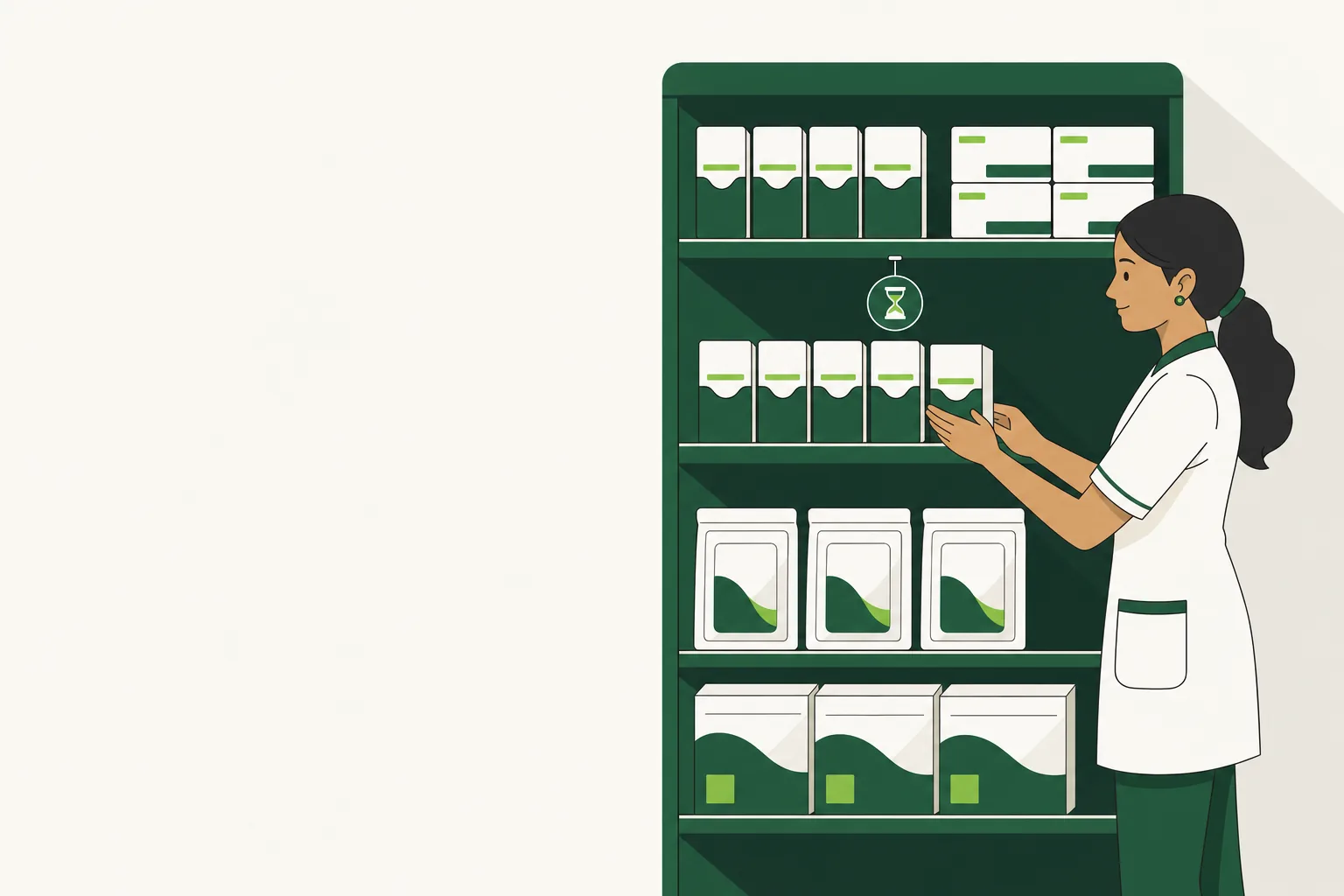
ShelfLifePro tracks those dates with the same FEFO, at-risk, and alert engine that runs your drug inventory. Shortest-dated stock dispenses first, at-risk lots get flagged before the surveyor finds them, and the expiry report covers the whole DME shelf, not just the pharmacy side.
Pharmacy category presets now include
- Diagnostic supplies
- Sterile & wound care
- Respiratory supplies
- Ostomy & incontinence
Sterility dates are treated as expiry dates: lot-level capture at receiving, FEFO at dispensing, and alerts before anything on the shelf goes out of date.
Ten reports that answer 90% of inspection questions
Every report available as PDF, Excel, or on-screen. Date range filters. Full audit trail.
Controlled Substance Dispensing Record
Dispensing record for Schedules II-V with drug, strength, quantity, and date, generated straight from your recorded dispensing. Sorted chronologically, ready for state board review.
Schedule II Register (21 CFR Part 1304 format)
Controlled substance dispensing record with drug, strength, quantity, date, and a running balance computed from recorded receipts and dispensing. Insufficient history is flagged honestly, never papered over with fabricated figures.
Temperature Compliance Log
USP 797/800 compliant temperature records by unit, date range, and storage zone. Excursion incidents with corrective action documentation.
Lot Traceability Report
Full chain for any product: distributor invoice → lot number → stock entry → every sale transaction. Searchable by lot or product.
Expiry Summary
All products by expiry window: expired, expiring this week, this month, next 3 months. Value at risk for each window. Return window status per supplier.
Controlled-Substance Inventory Record
The biennial or ad-hoc physical count as of opening or close of business, with the witness credential and two signature boxes. Schedule I/II on a separate record from III–V, as 21 CFR 1304.04 requires. Immutable once confirmed; retained two years.
Theft / Loss Report (DEA Form 106 / Health Canada)
Registrant, discovery, type, police report, prior-24-month count, corrective measures, substances by NDC or DIN. Prepared for submission on the DEA or Health Canada portal; the incident number you receive is recorded against it.
DSCSA Transaction Records (TI/TS)
Transaction information and transaction statement for every prescription-drug receipt, tied to the lot and the serials received, retrievable by NDC, lot or date for the six-year retention period.
Form FDA 3911 Packet
All 24 items with the form’s verbatim labels, built from the suspect-product investigation. PDF and CSV, marked “prepared for submission”. The 24-hour FDA and trading-partner notice clock runs as a task.
Trace-Request Response
For an FDA, state or partner request: the TI/TS, the lot trace from receipt to dispensing and the serials involved, assembled from records you already hold. Due by the end of the next business day; the due date runs as a task.
Pharmacy compliance FAQs
The questions pharmacists ask before signing up (and the honest answers)
The next audit is coming. Your compliance records should be ready before you are.
Start your free trial. Get your compliance reports running before the inspector arrives.