DSCSA for pharmacies, on the receiving dock instead of in a binder
Until now, expiry software sold to a US pharmacy stopped at the lot. The record a DEA or Board of Pharmacy inspector asks for first, the biennial controlled-substance inventory, the theft/loss report with its one-business-day clock, and the DSCSA transaction record with its six-year retention, lived in a binder or in nothing at all.
ShelfLifePro now holds all three, on the same batches the POS sells from. The physical count is witnessed and immutable. The loss report is prepared in DEA Form 106’s own fields with the statutory deadlines running as tasks. Every prescription receipt carries its transaction information and statement from an authorized trading partner, pushed to us as EPCIS by the wholesaler or recorded by hand. Suspect product is quarantined so the till cannot sell it, the Form FDA 3911 packet is prepared from the investigation, and a trace request is answered from records the pharmacy already holds.
Priced in USD. No credit card to start. Small-dispenser exemption runs to 27 November 2027; the rest applies today.
What an inspector asks for first
Not the expiry report. These three, in this order, and each one has a statute with a clock in it.
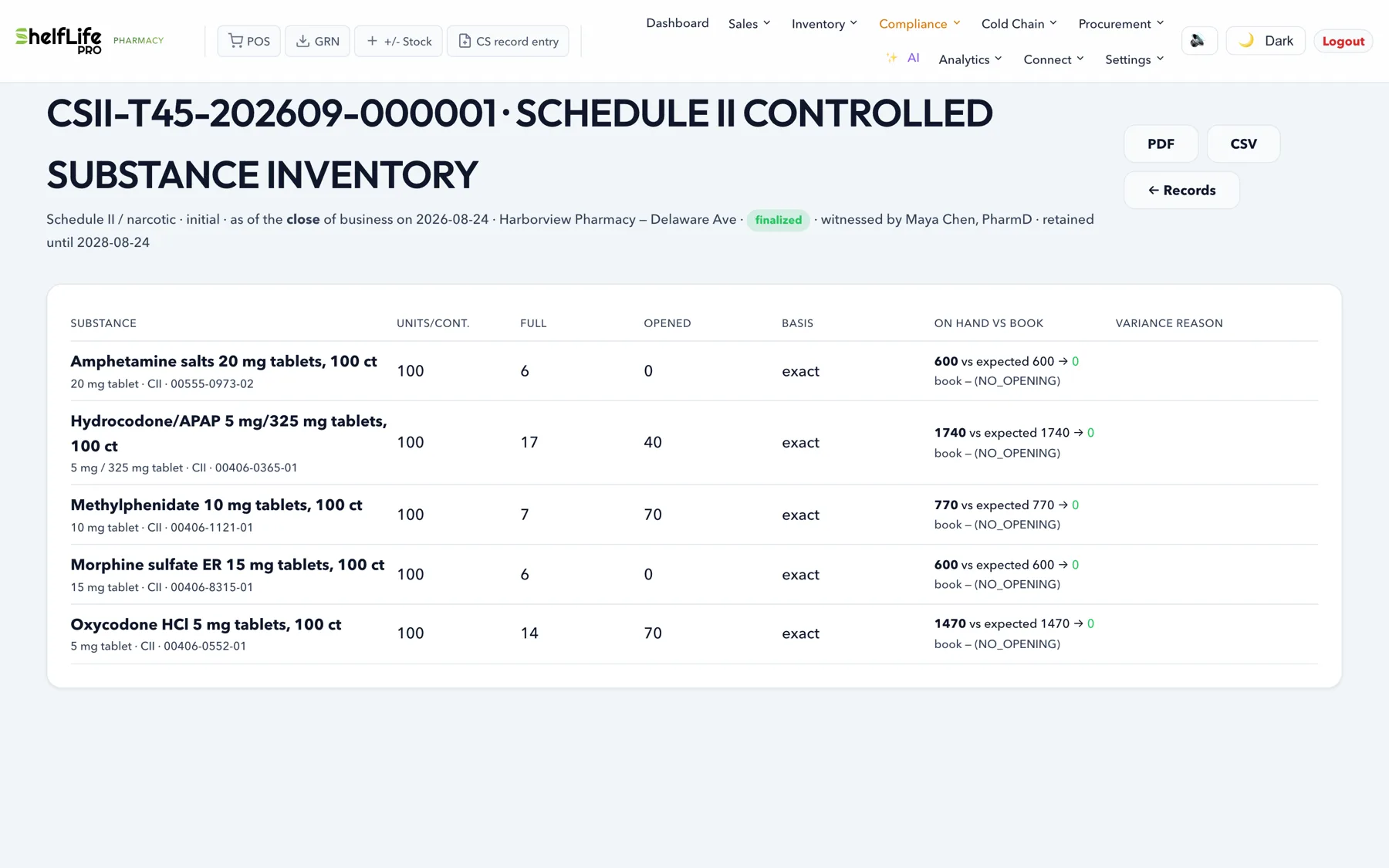
Controlled-substance inventory record
21 CFR 1304.11 · 1304.04
- Biennial, initial, newly-scheduled or ad-hoc count, as of opening or close of business
- Exact count for Schedule II and for containers over 1,000 units; estimate allowed otherwise
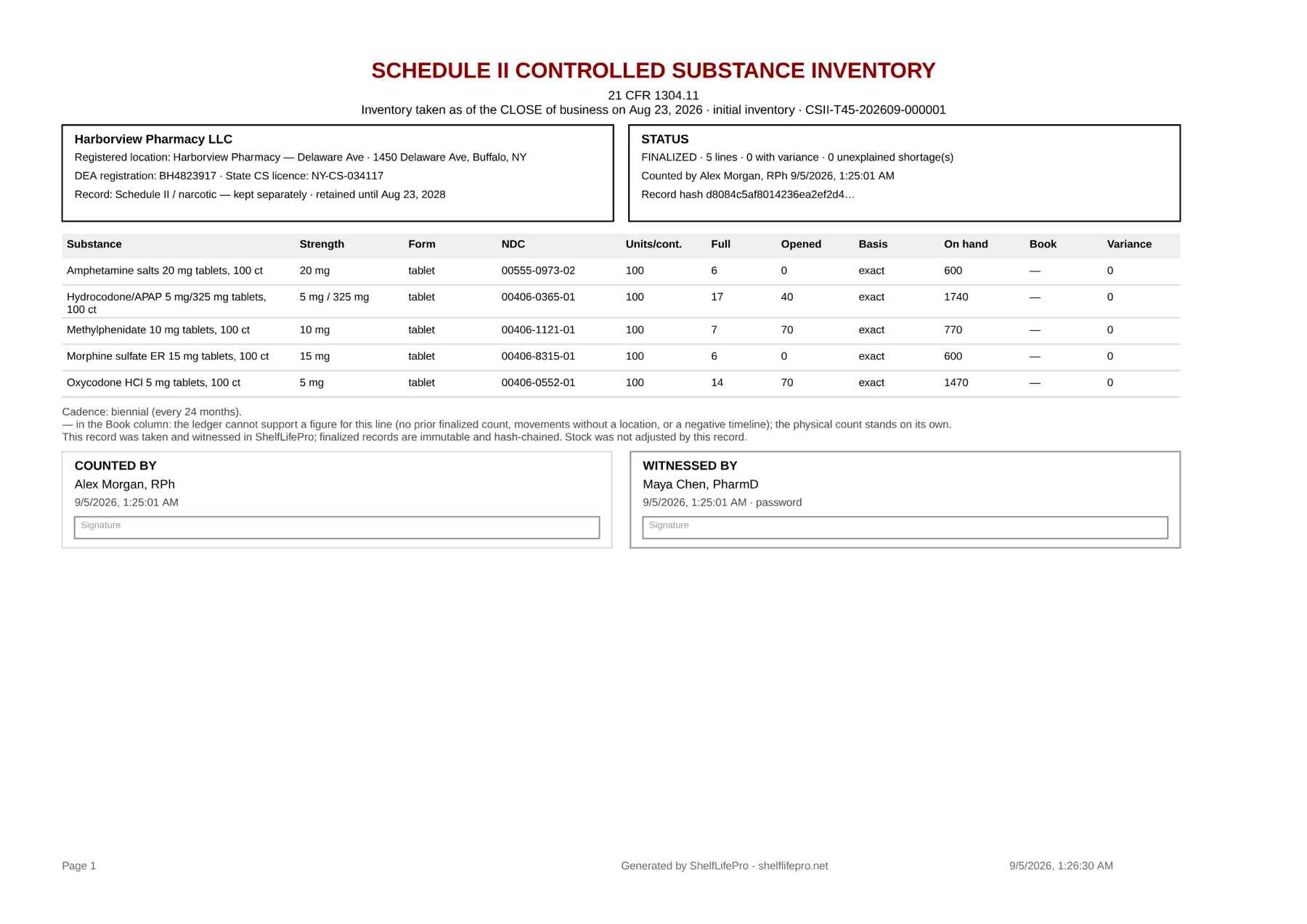
- Blind counting; a second person with a credential witnesses; then immutable, retained two years
- Schedule I/II record kept separate from III–V; PDF with two signature boxes
- Book-vs-physical reconciliation says “cannot compute” when the ledger has gaps
Theft / loss report
DEA Form 106 · 21 CFR 1301.76(b) · Health Canada
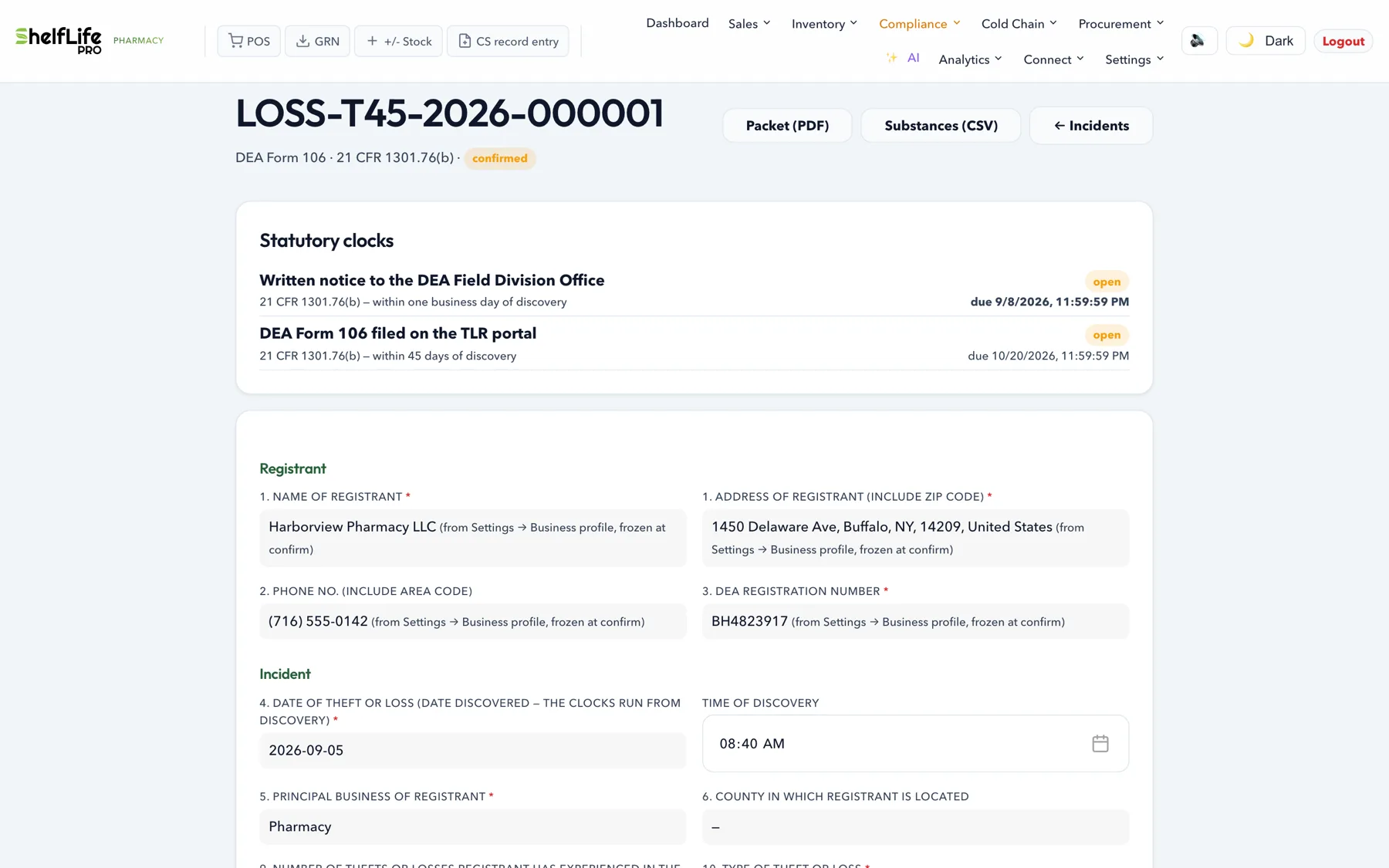
- The form’s fields, not ours: registrant, discovery, type, police, prior-24-month count, corrective measures, substances by NDC or DIN
- The six 21 CFR 1301.76(b) significance factors recorded on the incident
- Clocks as tasks: DEA Field Division notice within one business day (federal holidays observed), Form 106 within 45 days
- Health Canada within 10 days, regardless of amount
- Core facts freeze on confirm; amendments are counted and audited; stock is only adjusted by an explicit action
Transaction information + statement
FD&C Act §582(d)(1)(A)
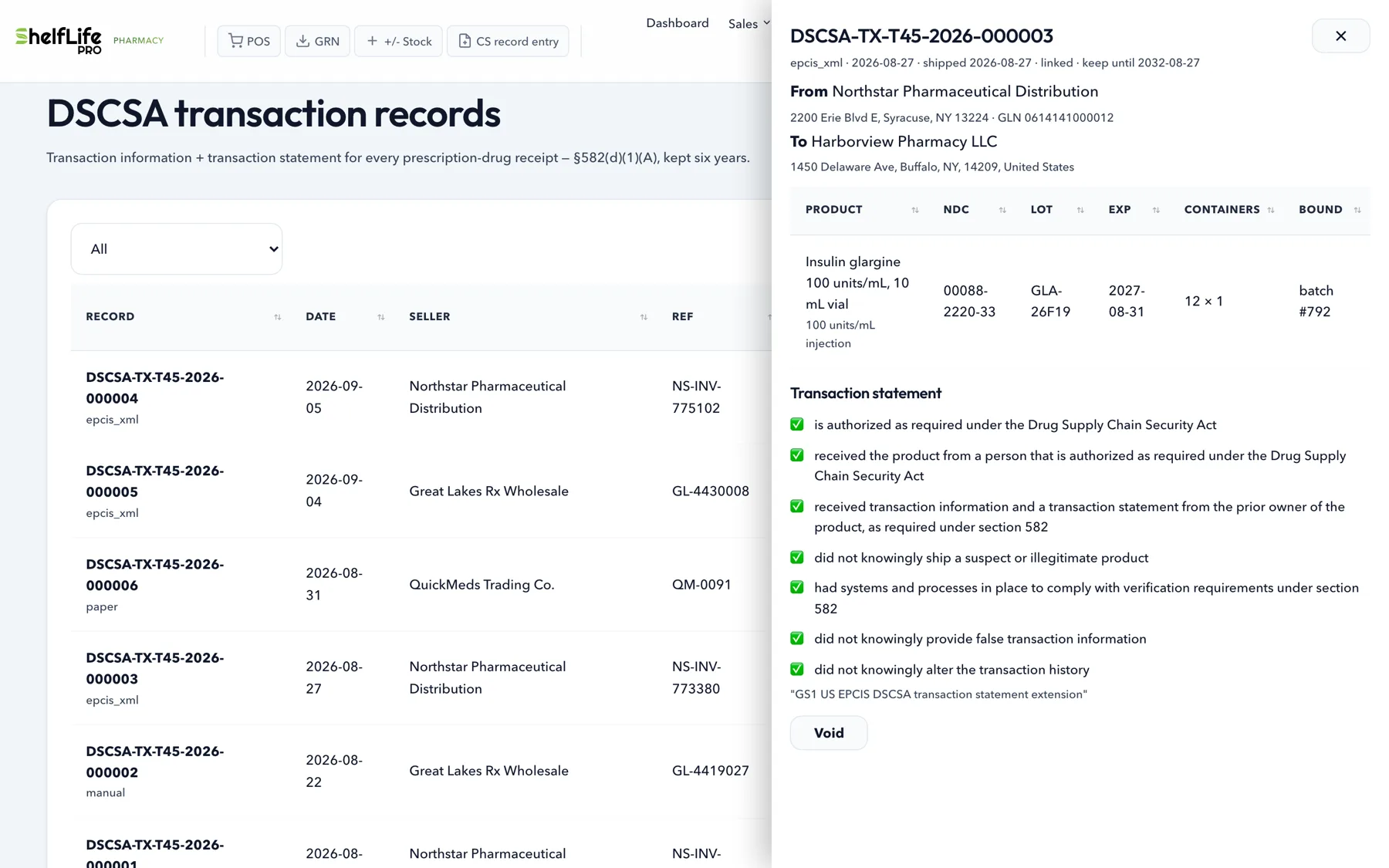
- TI and TS on every prescription-drug receipt, the seven affirmations in the statute’s words
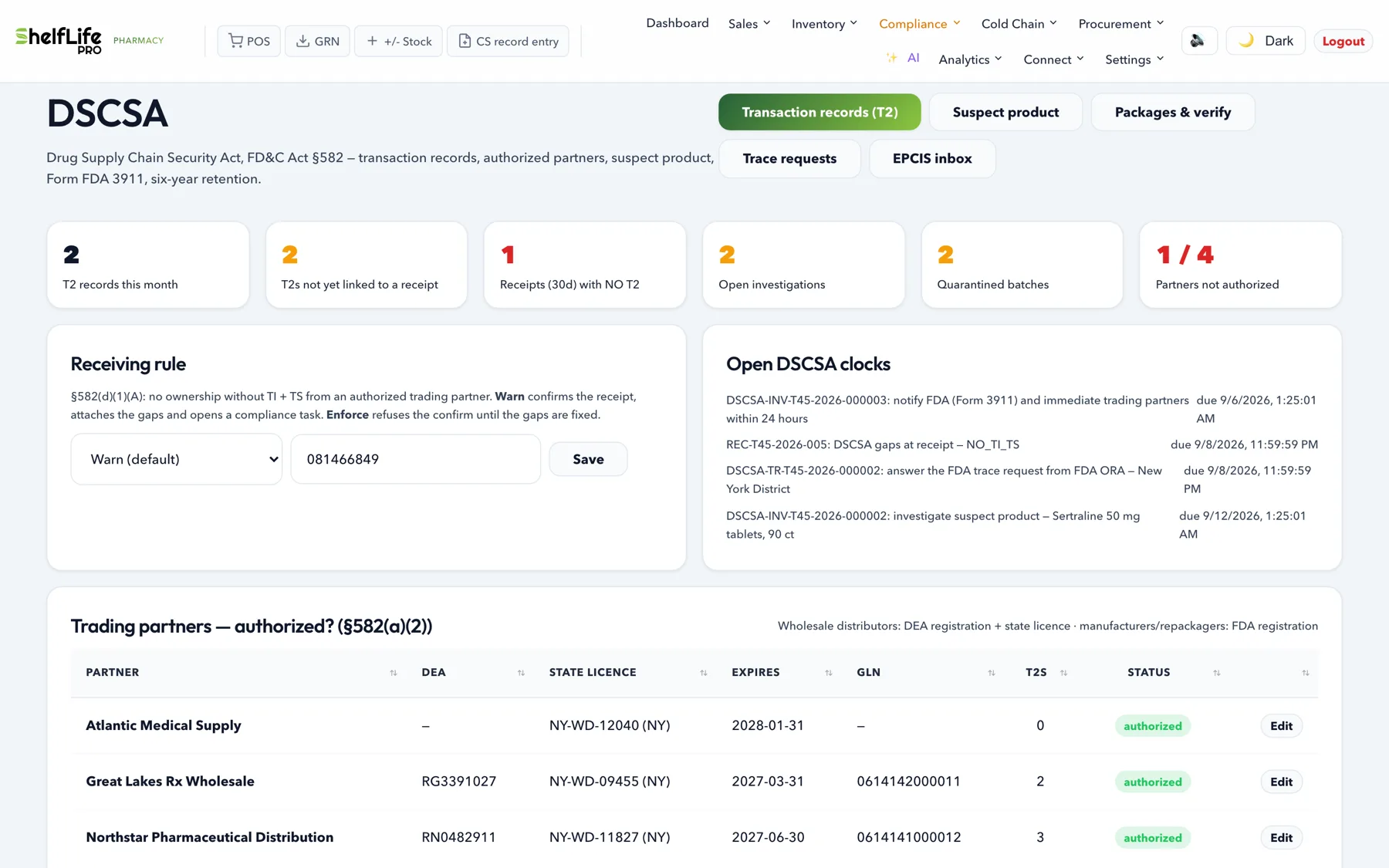
- Supplier checked as an authorized trading partner at receipt
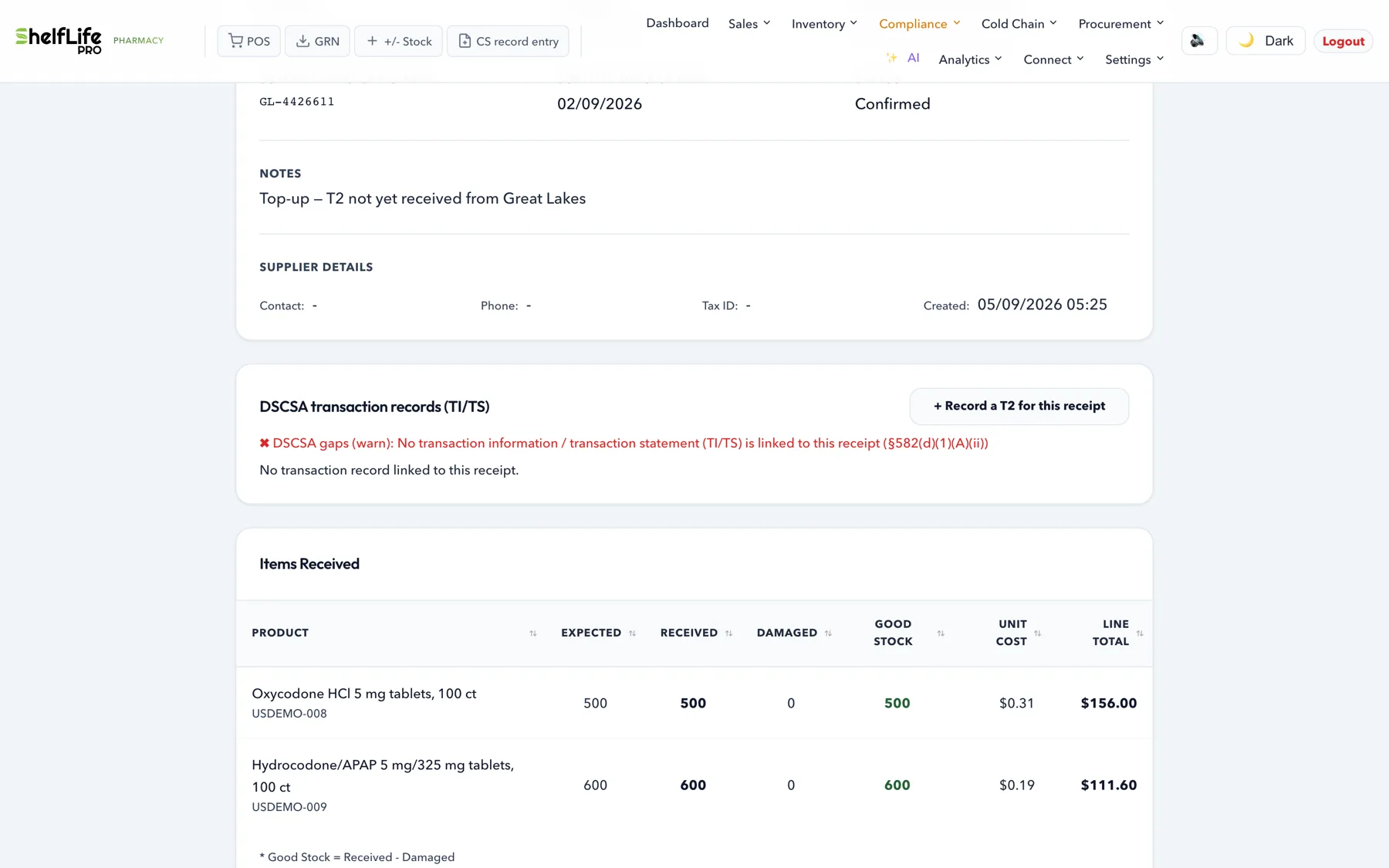
- Warn (default) or block the confirm until TI/TS is on file
- Six-year retention enforced by the database, not by policy
- Pushed to you as EPCIS by the wholesaler, or recorded by hand
The dispenser’s DSCSA obligations, one by one
Each row is a claim in the wording we are prepared to stand behind, the statute behind it, and the integration test suite that pins it.
| What ShelfLifePro does | Statute | Suite |
|---|---|---|
| Transaction information and transaction statement recorded for every prescription-drug receipt; the seven TS affirmations are the statute’s own words | §582(a)(25)–(26), (d)(1)(A) | 62 |
| Authorized-trading-partner check at receipt: DEA registration or state-licence evidence on the supplier | §582(a)(2), (d)(1)(A)(i) | 62 |
| Receiving rule you choose: warn (default), or block the confirm until TI/TS is on file | §582(d)(1)(A) | 62 |
| Six-year retention enforced by the database: a receipt, batch or sale inside retention cannot be deleted | §582(d)(1)(A)(iii), (d)(4)(A)(iii) | 62, 63 |
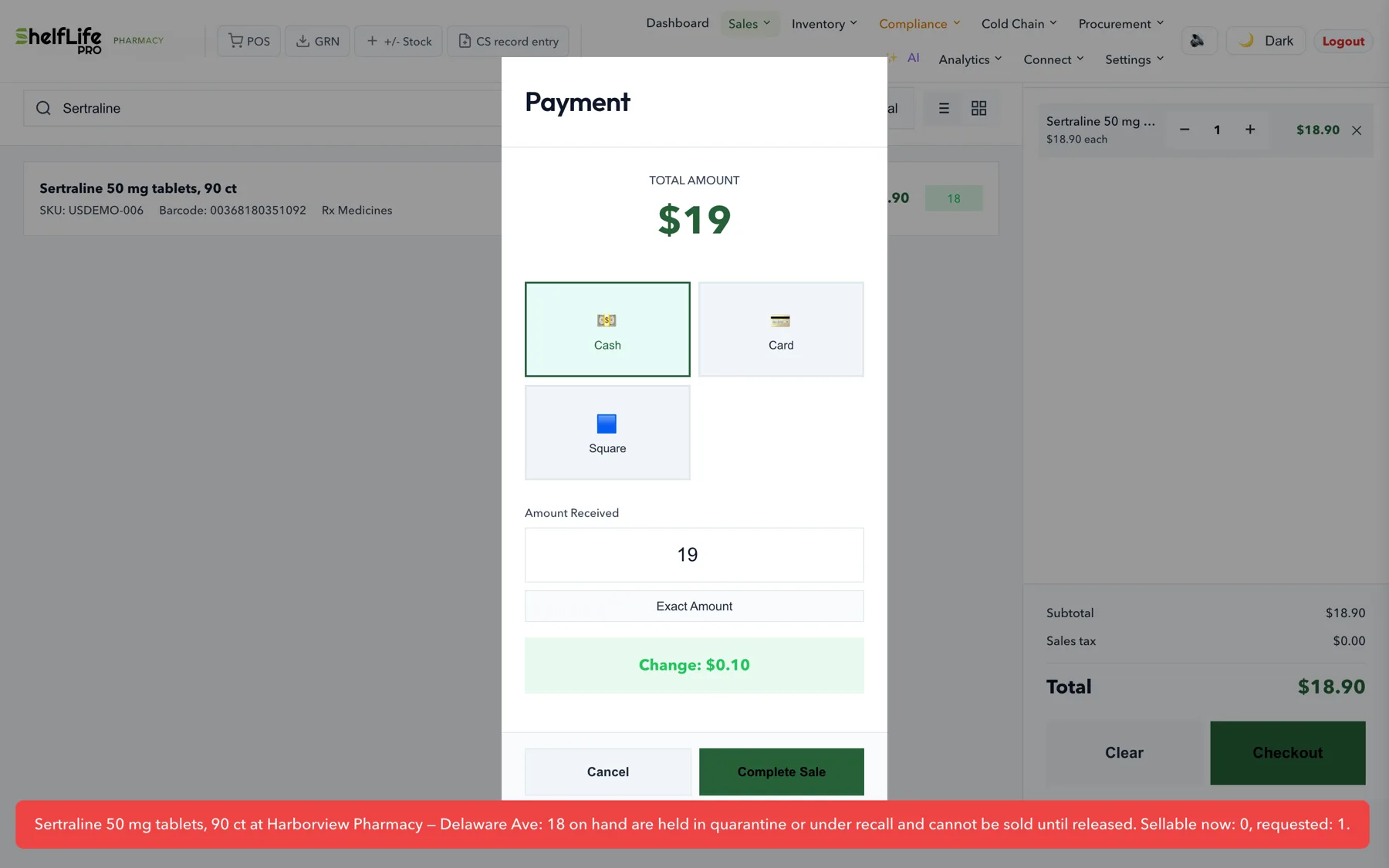
| Quarantine that actually blocks the sale, on every sale path including offline POS | §582(d)(4)(A)(i) | 62, 04 |
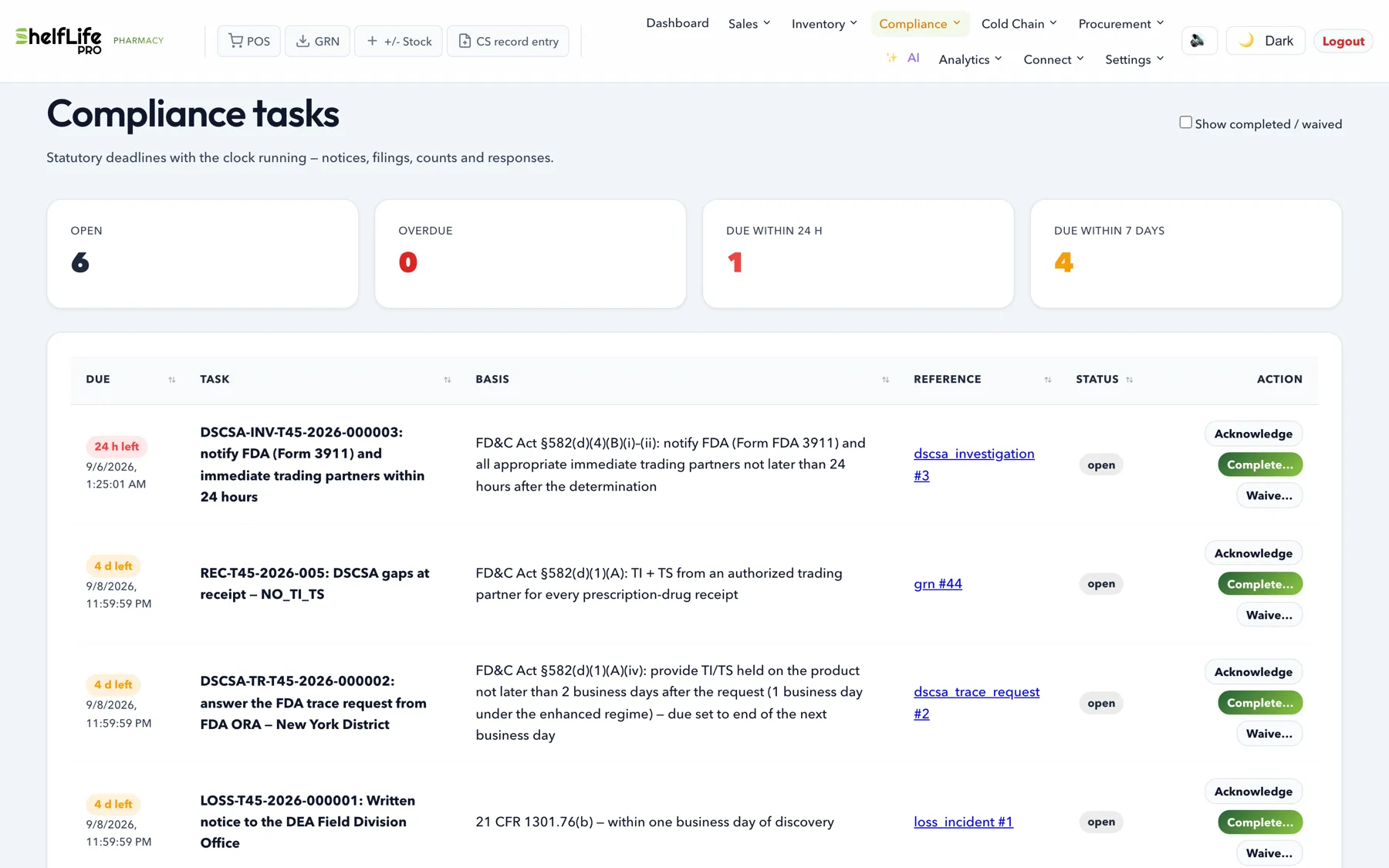
| Suspect → illegitimate workflow, classification in Form FDA 3911’s own terms, 24-hour FDA and trading-partner notice clock | §582(d)(4)(B) | 62 |
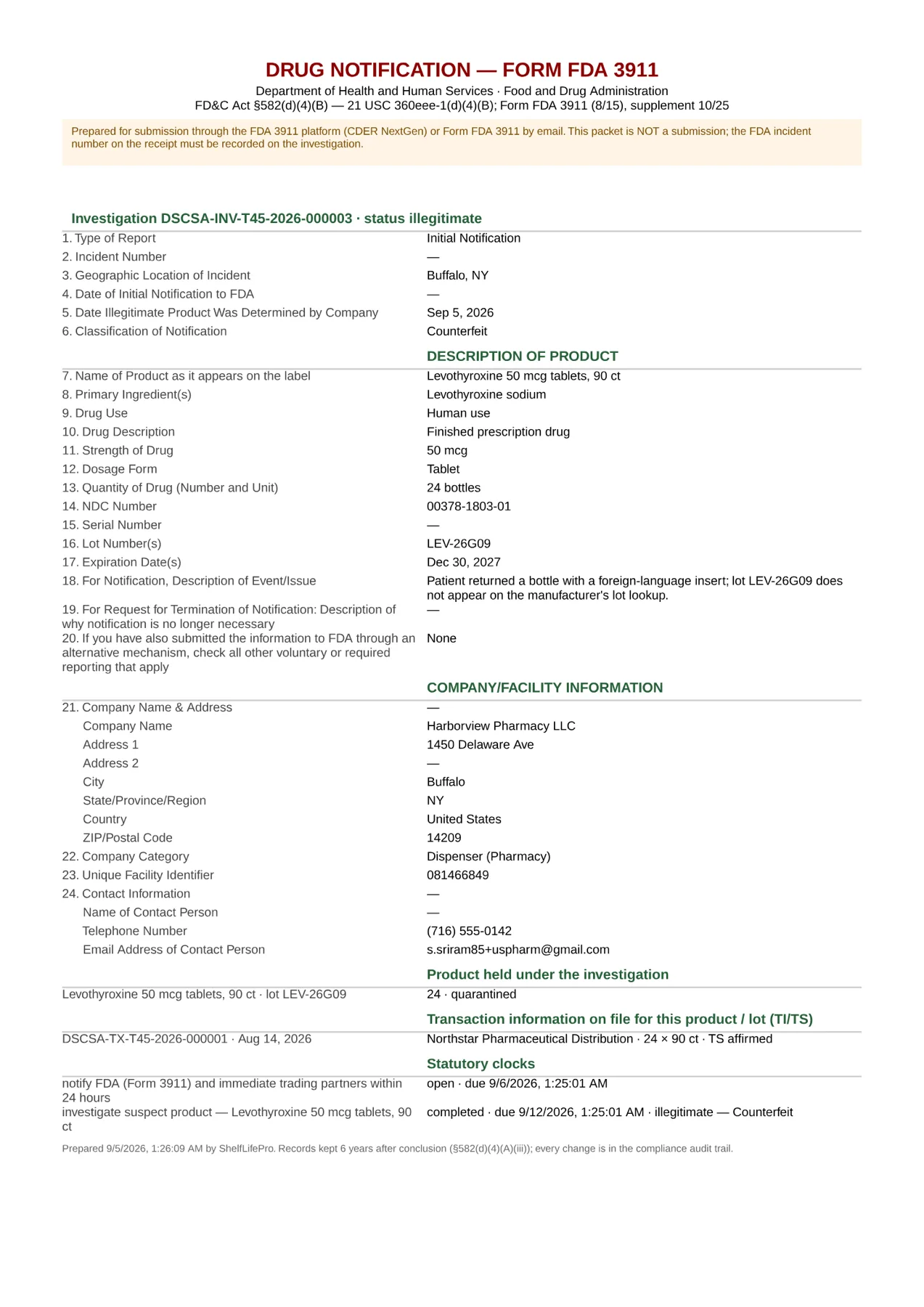
| Form FDA 3911 packet: all 24 items with verbatim labels, PDF and CSV, marked “prepared for submission, not a submission” | Form FDA 3911 (8/15), supplement 10/25 | 62 |
| Package serials: expected from the wholesaler’s data, received by scan, verified against the pharmacy’s own records, dispensed at the till | §582(a)(14), (d)(4)(A)(ii) | 63 |
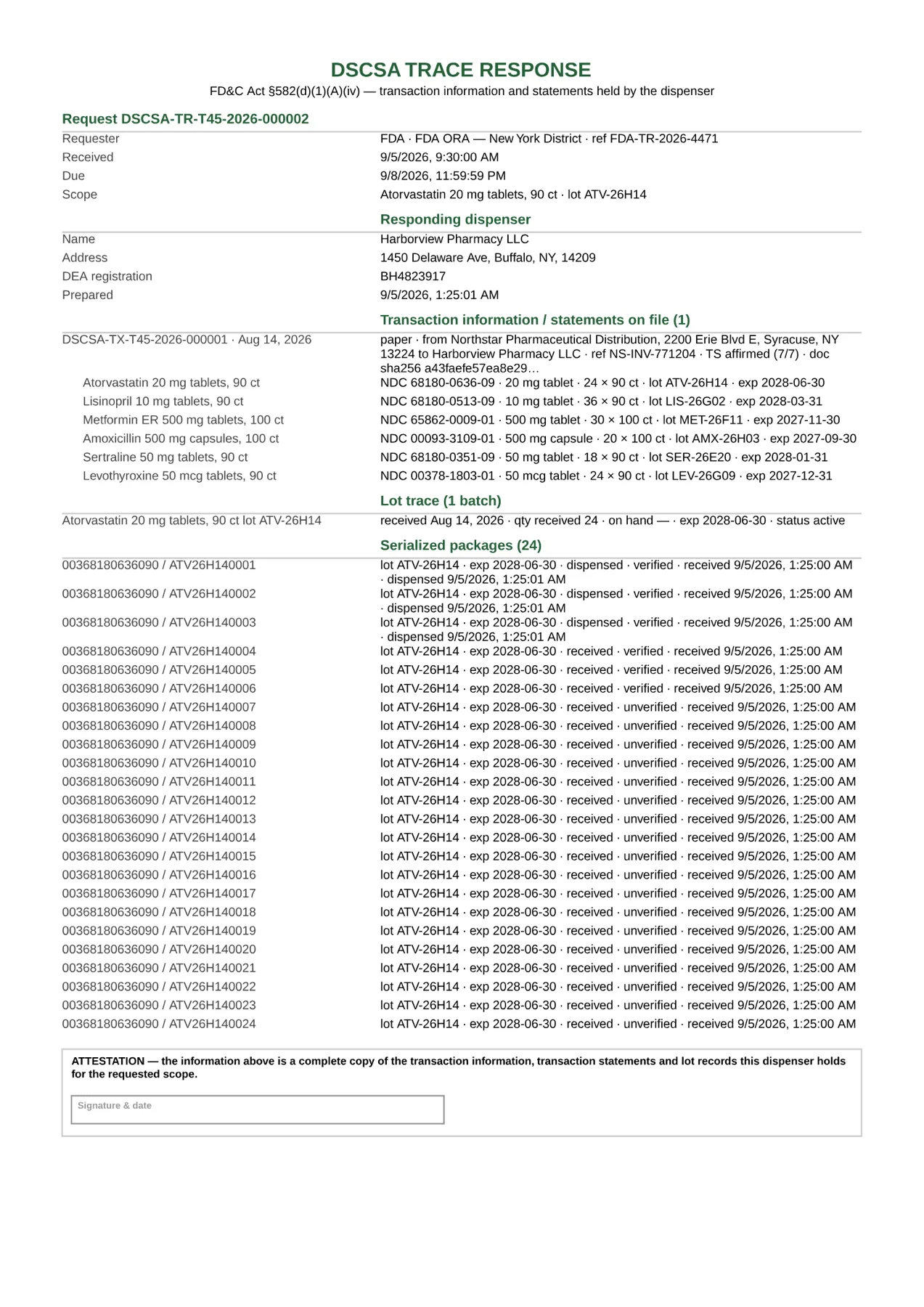
| Trace-request desk: FDA, state or partner request logged, answer built from TI/TS, lot trace and serials, due by the end of the next business day | §582(d)(1)(A)(iv) | 63 |
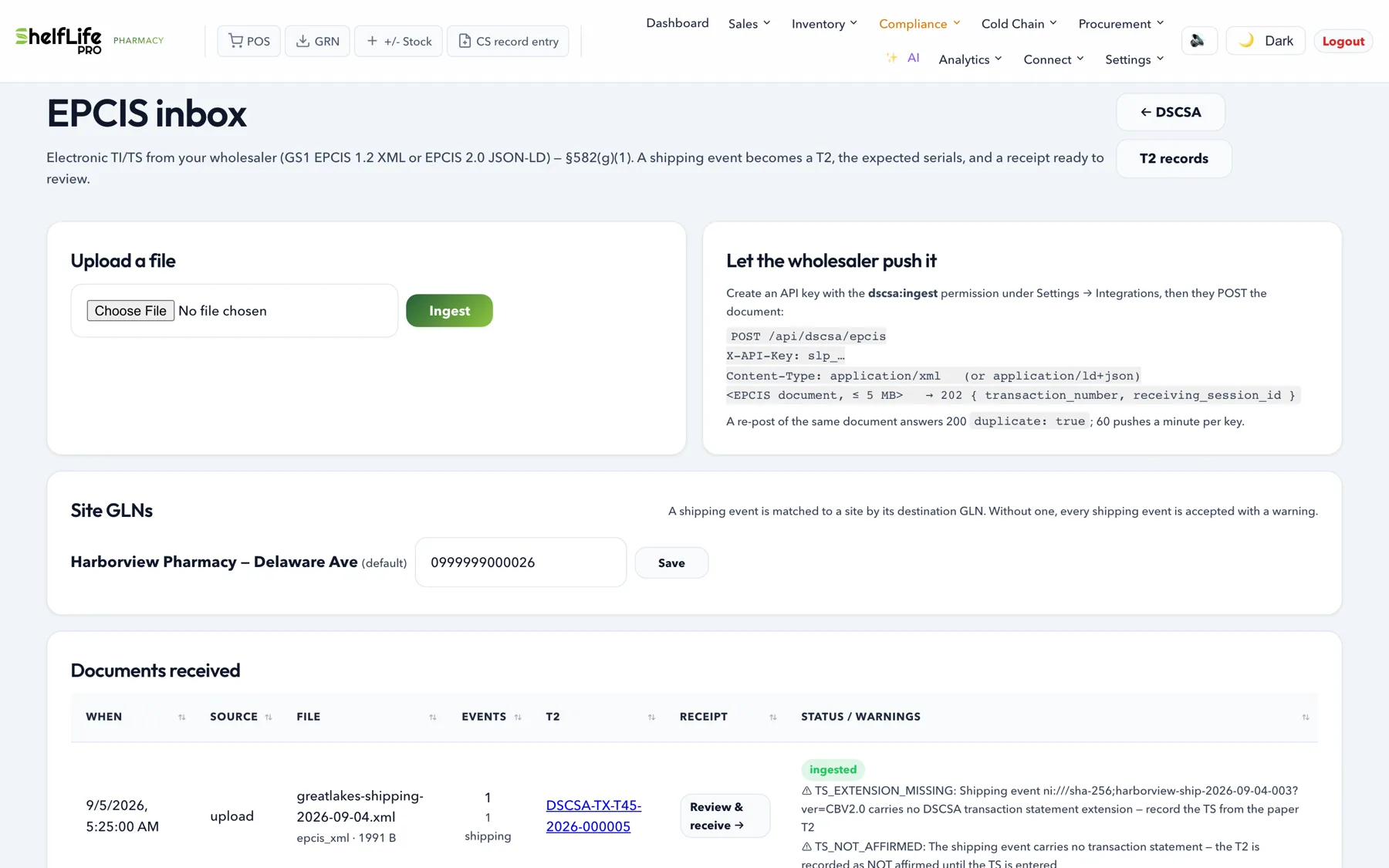
| EPCIS 1.2 XML and EPCIS 2.0 JSON-LD ingestion: file upload, or the wholesaler pushes to an API key | §582(g)(1) | 64 |
Suite numbers refer to ShelfLifePro’s integration test suites; each runs against every release. The suspect-lot sample rule (3 or more packages, or 10%) is FDA guidance we track, not a guarantee of anything.
Where each record is made
No separate compliance screen to remember. The record is a by-product of receiving, selling and counting.
At receiving
The wholesaler’s EPCIS lands by upload or API push. TI/TS attach to the receipt; the supplier’s authorization is checked; expected serials are listed for scanning.
When something looks wrong
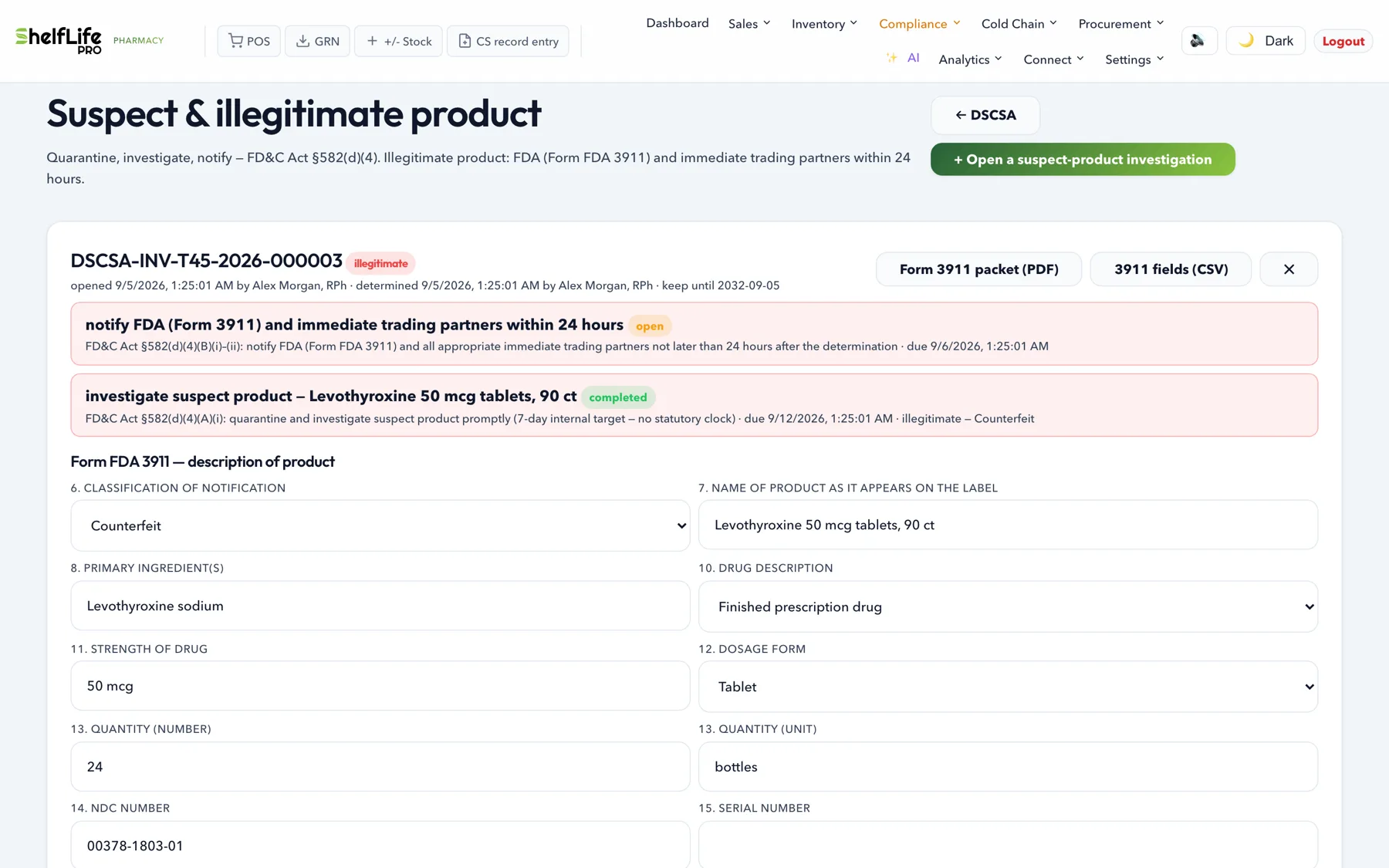
Quarantine the lot. Every sale path refuses it, including offline POS. The investigation classifies in Form FDA 3911’s terms and starts the 24-hour notice clock.
At the till
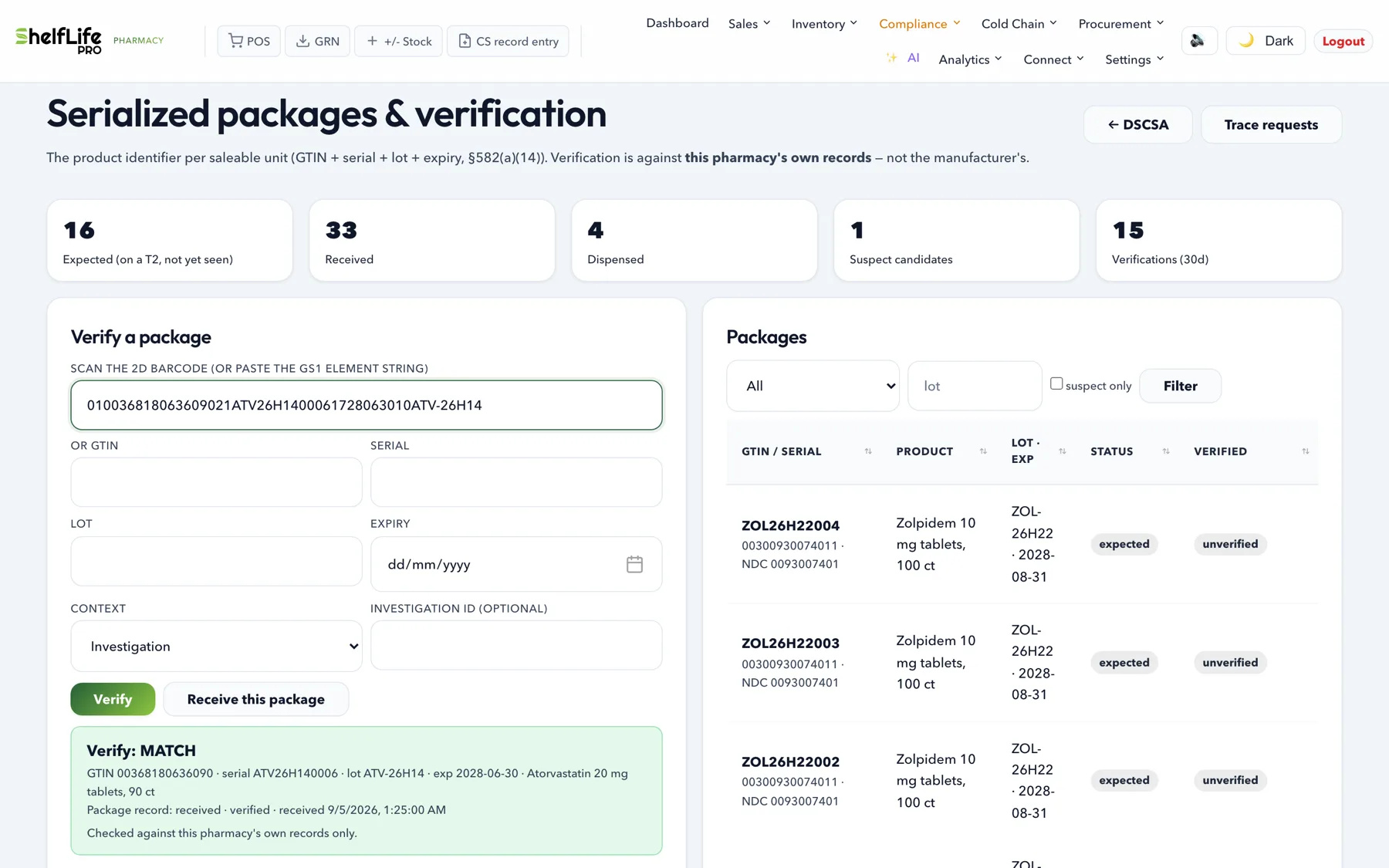
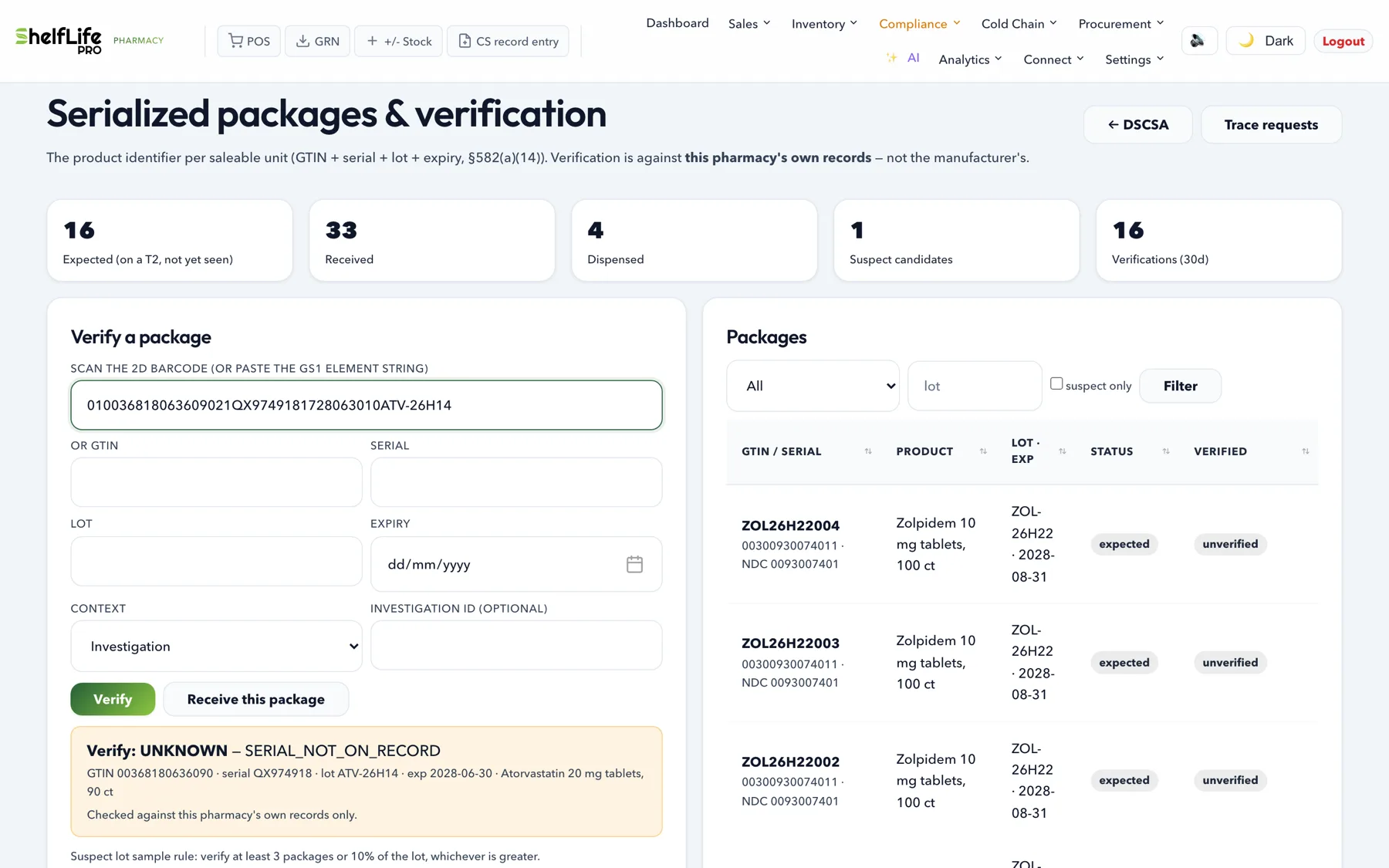
A scan of the DataMatrix verifies the package serial against your own receipts and dispenses it. A serial you never received shows as unknown origin and stays out of the sale.
When a request arrives
Log the FDA, state or partner request. The answer is built from TI/TS, the lot trace and the serials, with the next-business-day due date running as a task.
What it looks like on a live pharmacy
Shot on the ShelfLifePro demo pharmacy on app.shelflifepro.net. Every record on these screens was made by the product, not mocked.
What this is not
- No manufacturer verification. Serials are verified against your own receipts, not with the manufacturer or a VRS network.
- No DEA Form 222 or CSOS ordering. Controlled-substance ordering keeps its existing process; the register records the stock movement.
- We file nothing. The Form FDA 3911 and DEA Form 106 packets are prepared for the pharmacist to submit on the FDA or DEA portal. The incident number you get back is recorded.
- Dispenser obligations only. Not a wholesaler-side or manufacturer-side DSCSA system.
- EPCIS in, not out. We accept your wholesaler’s shipping events (1.2 XML, 2.0 JSON-LD) with the GS1 US transaction-statement extension. We do not send EPCIS and we do not consume every vendor’s private extension.
- Not legal advice. Check the cited statute with your compliance counsel or Board of Pharmacy.
The small-dispenser exemption now ends 27 November 2027
On 6 August 2026 FDA extended its exemption for small dispensers from the package-level, electronic, interoperable exchange under §582(g)(1). That is the serialized part. It is not an exemption from the rest of the dispenser’s obligations, which apply today: transaction information and statement on every receipt, authorized trading partners, six-year retention, quarantine and investigation of suspect product, and answering a trace request within two business days.
ShelfLifePro handles the exempt part too, so the 2027 date is not a migration. Pharmacies that start scanning serials now find the unknown-origin packs before an inspector does.
What still applies today, in detailPro Growth
The records every US dispenser is bound by today
- Controlled-substance inventory record (21 CFR 1304.11)
- Theft / loss reporting (DEA Form 106, Health Canada)
- DSCSA core: TI/TS, authorized partners, quarantine, suspect-product investigations, Form FDA 3911 packet, six-year retention
- Compliance tasks with statutory due dates, e-mail reminders, hash-chained audit trail
Enterprise
Adds the serialized part
- Package serials expected, received by scan, dispensed at the till
- Verification against your own records; unknown-origin scans flagged
- Trace-request desk with the next-business-day due date as a task
- EPCIS 1.2 XML and 2.0 JSON-LD ingestion by upload or API key
Questions pharmacists ask
Straight answers, with the limits stated.
See the three records on a live pharmacy
A 30-minute walk-through: a receipt with its TI/TS, a quarantined lot refused at the till, a witnessed count, and a Form 106 with the clock running.
Sources: 21 CFR 1304.11, 1304.04, 1301.76(b) (eCFR); 21 USC 360eee-1 §582; FDA “Exemptions under DSCSA”; Form FDA 3911 (8/15) and supplement (10/25); Health Canada CS-GD-005; OCP “Controlled Substances — Security and Reconciliation”; GS1 EPCIS 1.2 / 2.0 and the GS1 US healthcare DSCSA implementation guideline. Nothing on this page is legal advice.